
Greening Schools for Biodiversity
Last updated on 9 September 2026
Greening Schools for Biodiversity Overview
Open to all primary schools (upper primary), secondary schools and junior colleges, the Greening Schools for Biodiversity programme involves the targeted planting of native, biodiversity-attracting plants.
This greening process brings students and teachers closer to nature without leaving their school yard and creates new habitats for plants and animals.
Learning objectives
This programme aims to:
Educate students and teachers on how to identify the different plant and animal species that can be found in their school compounds.
Encourage teachers and students to learn about, appreciate and support local biodiversity.
Encourage student participation in caring for their school grounds and the environment.
Promote the exchange of information and expertise in enhancing biodiversity in schools.
Programme structure
Each programme cycle is 12 months long, and schools are encouraged to adopt it for at least 2 to 3 cycles.
Refer to the following to find out the activities within a cycle:
Training for Teachers
Training is provided in the following formats to guide students through the programme:
Table caption
Training format | What to expect |
|---|---|
Teachers' workshops | An introduction to native biodiversity, basic identification of flora and fauna, and techniques in conducting biodiversity surveys. |
Outdoor guided walk | An introduction to, and familiarisation with, creating biodiversity trails. |
We encourage teachers to train students through students' workshops using the materials provided so that they have a sufficient understanding of native biodiversity to carry out the programme themselves.
Biodiversity Audit
Students are to conduct at least 2 biodiversity audits during a programme cycle. These will happen:
In May during the BioBlitz for Schools, held in conjunction with Biodiversity Week for Schools.
At least 3 months after BioBlitz for schools for monitoring purposes.
During the audits, students will survey the flora and fauna found in their school, and record their observations on data sheets and the SGBioAltas mobile app.
Customised Horticultural Sessions
Horticulturists engaged by NParks will conduct customised horticultural sessions which cover topics such as:
Guided walk on school grounds
Plant propagation
Design a planting layout plan
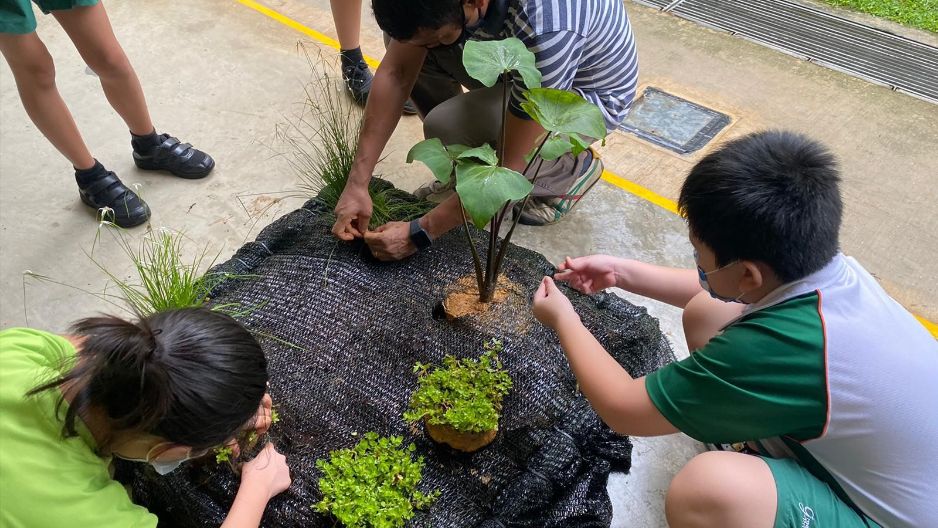
Greening on Selected Plots
After completing all horticultural sessions and the first biodiversity audit, students are to carry out greening on selected plots within their school compound.
These plots will be selected with the help of NParks, which will also provide inputs in selecting suitable biodiversity-attracting flora.
Greening can involve any of the following:
Planting biodiversity-attracting flora.
Propagating existing plants.
Building floating wetlands in the school's aquatic habitats.
Implementing the Biodiversity Trail
During the final phase of a cycle, students will need to:
Create a biodiversity trail (or enhance an existing one) in their school with guidance.
Conduct a guided walk of the trail for their peers or members of the community.
Compiling the greening schools' journal
At the end of each cycle, both teachers and students are to submit reflections on the project and photographs taken throughout the greening journey.
How to register
Email us to register your interest or to find out more information.