
Oriental Pied Hornbill
About the Oriental Pied Hornbill in Singapore
Last updated on 29 May 2026
.jpg)
The Oriental Pied Hornbill (Anthracoceros albirostris) is is one of the most striking and easily recognisable birds in Singapore. With its large, curved bill topped by a casque (a hollow structure on top of the bill), this black-and-white bird often catches the eye as it moves through parks and wooded areas.
Once considered extinct in Singapore, the Oriental Pied Hornbill is now a wonderful conservation success story.
Identifying features
Check out some of the identifying features of the Oriental Pied Hornbill below.
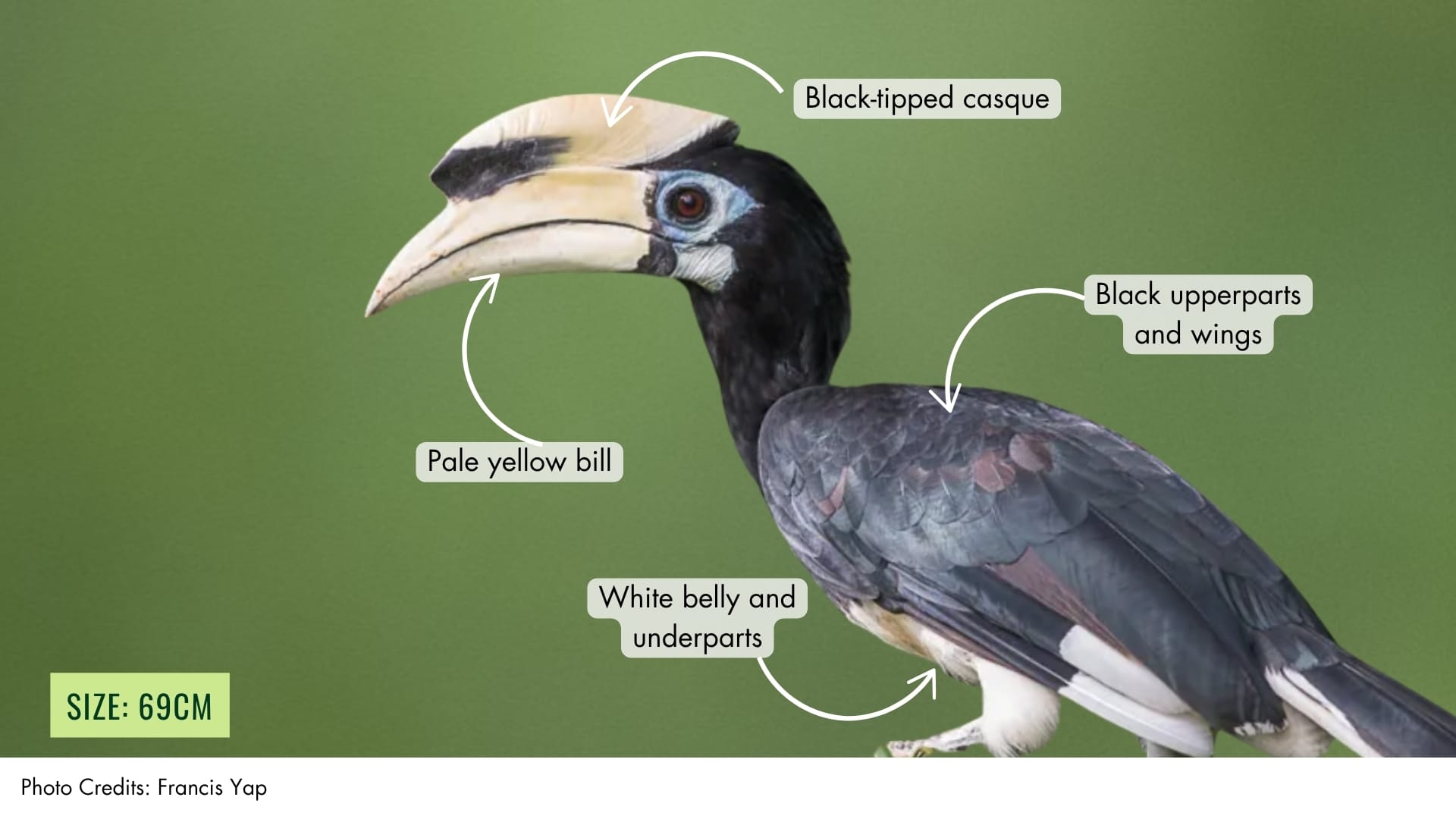
The Oriental Pied Hornbill has a pale yellow bill, black upperparts and wings, and white belly and underparts. While males are generally larger in size, have a bigger casque and red eyes, females are smaller, have a smaller casque and a black-tipped bill.
Their loud, cackling calls are also a giveaway that a hornbill is nearby!
Interested to learn more about how to identify Garden Birds? Check out our simple guide on identifying Garden Birds (opens in new tab)!
Habitat and ecology
These noisy and social canopy-dwelling birds are found in urban areas bordering green spaces, especially when there are fruiting trees present.
Mating pairs typically nest in holes in trees, with the males gathering and delivering food for the females and their chicks sealed inside the hole with a plaster of mud and fibres.
Did you know?
Oriental Pied Hornbills were once extinct in Singapore due to habitat loss. As the Hornbills need large tree cavities to nest, the deforestation and loss of our big trees resulted in their subsequent decline.
Thanks to dedicated conservation efforts such as through the building of artifical nest boxes, they began returning in the 1990s. Today, these charismatic birds are a symbol of successful wildlife conservation in Singapore, and they can often be spotted in places like Pulau Ubin, Sungei Buloh Wetland Reserve, and even urban parks.
Frequently asked questions
Q: What is the difference between Toucans and Oriental Pied Hornbills?
Most people mistake our local Oriental Pied Hornbills for Toucans. Toucans lack a casque and are native to Central and South America, while Hornbills have casques and are found in Asia and Africa.
.jpg)
Join us at Garden Bird Watch
Enjoy birdwatching, or interested to learn more about birds you see in our parks and gardens? Join us for Garden Bird Watch to collect valuable data about garden birds, which contributes to their conservation.
Learn more about the Oriental Pied Hornbill!
Curious about the Oriental Pied Hornbill? Here are some interesting articles you can read to learn more about them.