Seagrass Pipefish
About the Seagrass Pipefish in Singapore
Last updated on 31 May 2026
.png)
You’d need a sharp eye to spot one of these long, narrow fishes, commonly found hiding in seagrass meadows. At low tide, the Seagrass Pipefish (Syngnathidae sp.) sometimes remains motionless, resembling a twig. Toothless, it uses its long snout and a suction mechanism to feed on small marine organisms.
Identifying features
Check out some of the identifying features of the Seagrass Pipefish below.
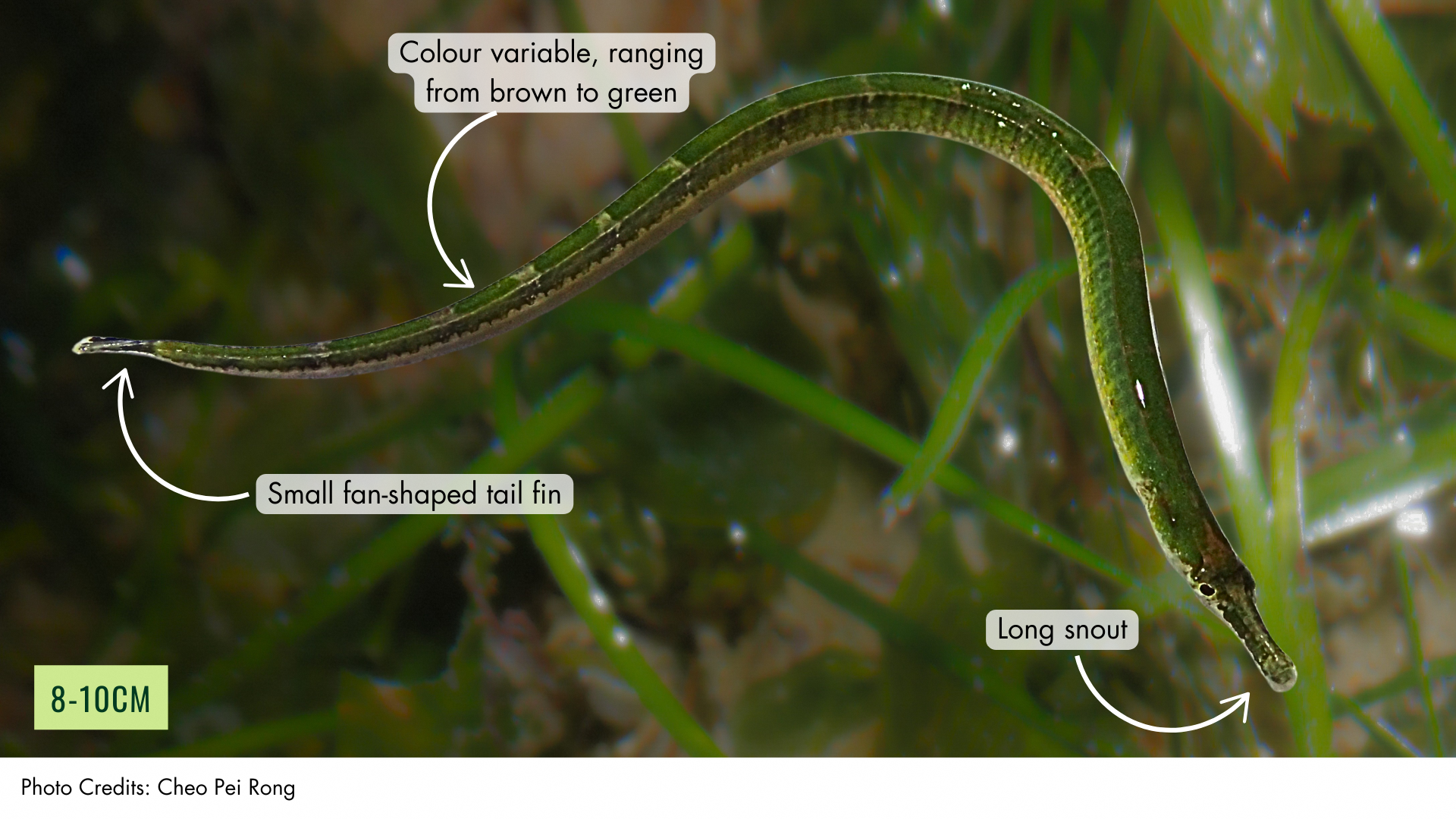
Seagrass Pipefish range from brown to green and feature a variety of patterns. Some have narrow pale bands spaced evenly along the body, while others may be plain. It also sports a distinctive long snout.
Habitat and ecology
Seagrass Pipefish are commonly found in seagrass meadows.
Did you know?
Like the closely-related seahorse, these fishes have bony armour on their bodies that gives them a spiky appearance. Seagrass Pipefish fathers also play an important role in the reproductive process, carrying fertilised eggs in brood pouches until the young are born live!
Learn more about the Seagrass Pipefish!
Curious about the Seagrass Pipefish? Here are some interesting articles you can read to learn more about them.