Cake Sand Dollar
About the Cake Sand Dollar in Singapore
Last updated on 31 May 2026
.png)
Look closely at a sandy stretch of the intertidal zone, and you might spot a small dull-coloured animal that looks like a flat disc. That is likely a Cake Sand Dollar (Arachnoides placenta). They’re often found in groups, half-buried in the sand.
A living Cake Sand Dollar is covered with tiny, velvety spines that move like little feet, helping it crawl slowly across the sand. These spines also help keep sand off its body so it can breathe properly.
Identifying features
Check out some of the identifying features of Cake Sand Dollars below.
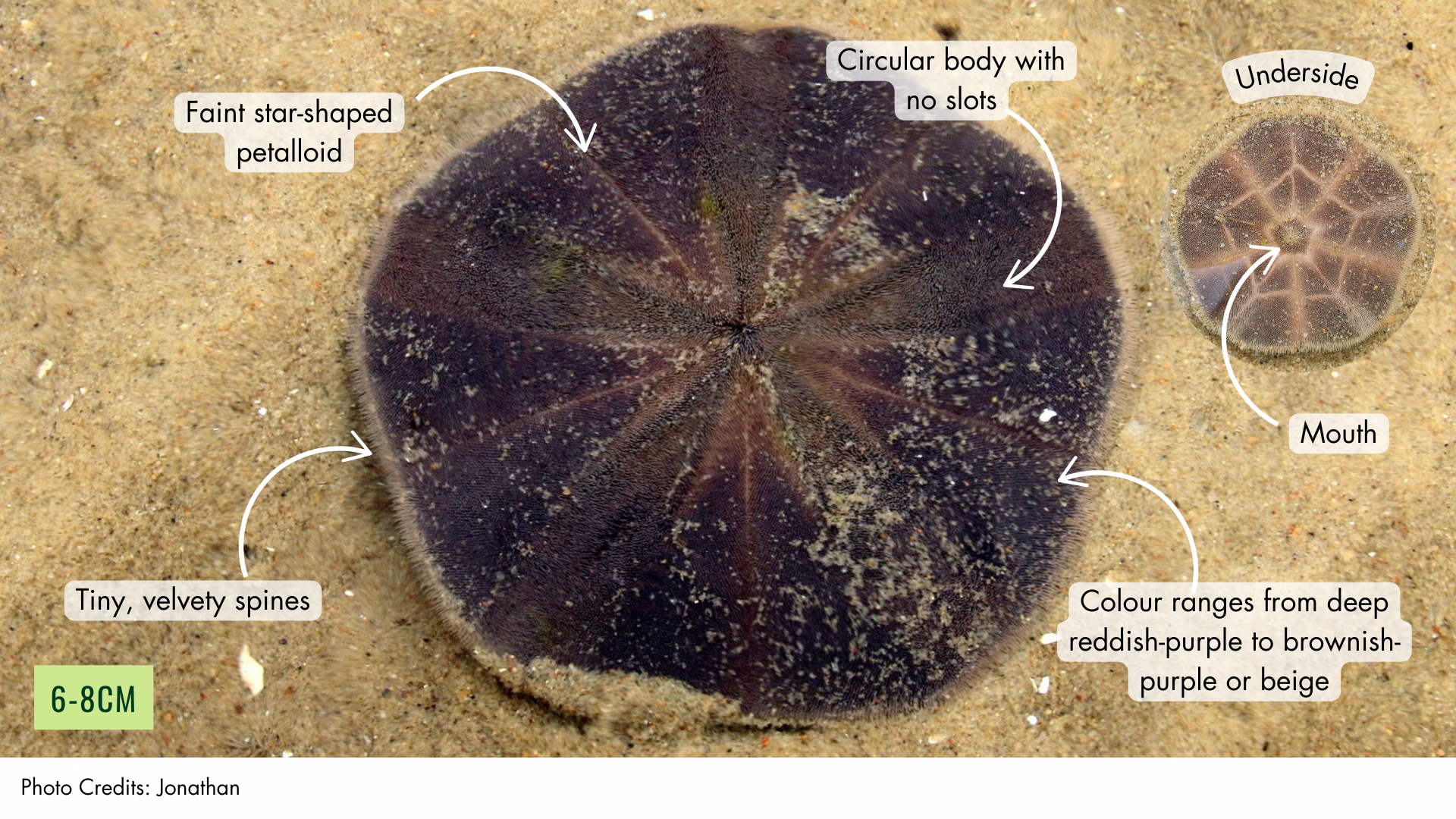
They range from deep red-purple, to brown-purple or beige in colour. There is a faint star shape on the top of the sand dollar, and its circular body has no slots or holes.
Habitat and ecology
Cake Sand Dollars are commonly found half buried in the sediment on sandy Northern shores. They are a food source for many other animals, include snails, sea stars, crabs, and even anemones.
Did you know?
If you find a sand dollar that is smooth and grey with no spines on its body, that may be a test – the skeleton that a sand dollar leaves behind after it dies.
Learn more about the Cake Sand Dollar!
Curious about the Cake Sand Dollar? Here are some interesting articles you can read to learn more about them.